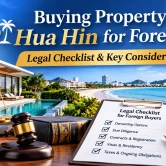



Hua Hin is one of the most popular places in Thailand for foreigners to buy a holiday home, a retirement villa or an investment condominium. The beach, the golf courses and the relaxed pace of life make it easy to fall in love with a property quickly. The legal side, however, works very differently from most Western countries, and mistakes made before signing are often expensive or impossible to fix later.
Pacific Law is based in Hua Hin and regularly assists foreign buyers with property transactions in Hua Hin, Pranburi, Cha-am and the wider Prachuap Khiri Khan area. This checklist explains what foreigners can legally own, what to check before paying a deposit, and what happens at the Land Office. It is general information only and not legal advice for your specific situation.
1. Decide What You Can Legally Own
Under the Land Code, foreigners generally cannot own land in their own name. In practice, most foreign buyers in Hua Hin use one of the following legal structures:
- Freehold condominium unit – foreigners may own condominium units in their own name, provided that foreign ownership in the building does not exceed 49% of the total unit area and the purchase money is brought into Thailand in foreign currency.
- Registered lease of land – a lease of up to 30 years, registered at the Land Office, is the most common way to hold a house or villa.
- Owning the building separately – a foreigner may own a house as a structure separate from the land, combined with a registered lease, superficies or usufruct over the land.
- Usufruct – a registered right to possess and use the property, often granted for the lifetime of the holder.
Each structure has advantages and limits. For a detailed explanation, read our guides on Foreign Land Ownership in Thailand and Buying a Condo in Thailand as a Foreigner.
2. Avoid Nominee Arrangements
Some sellers and agents still suggest buying land through a Thai company in which Thai shareholders hold shares only on paper on behalf of the foreign buyer. This is a nominee arrangement. It breaches the Land Code and the Foreign Business Act, and the consequences can include fines, criminal prosecution and an order to dispose of the land. If a deal only works with nominee shareholders, do not proceed until you have independent legal advice.
3. Check the Title Deed Before Paying a Deposit
Properties in Hua Hin are generally registered at the Hua Hin branch of the Prachuap Khiri Khan Provincial Land Office. Many projects just north of Hua Hin, in Cha-am, fall under Phetchaburi province and are registered at a different Land Office. Before any money changes hands, your lawyer should verify:
- The type of title deed – a Chanote (Nor Sor 4 Jor) is the strongest form of title. Lesser documents such as Nor Sor 3 Gor require closer review, and some land use documents cannot be leased or transferred at all.
- The registered owner – the person signing the contract must be the registered owner or properly authorised to sell.
- Registered encumbrances – existing mortgages, leases, servitudes, usufructs or court seizure orders.
- Boundaries and access – the land plot, its size and legal road access should match what you are being shown on site.
4. Check Permits for Villas and Off-Plan Projects
Hua Hin has a large number of new villa and condominium developments. When buying off-plan or from a developer, check the developer’s ownership of the land, the construction permit, the environmental impact assessment approval where one is required, and whether the building complies with local zoning and building regulations. Your lawyer should also review how your instalment payments are protected if construction is delayed or the project is not completed.
For one example of how building rules affect what you are buying, see Thai Building Control Laws: Balconies.
5. Review the Contract Before You Sign
Reservation agreements and sale contracts prepared by developers or agents usually favour the seller. Before signing, make sure the contract clearly covers:
- The exact unit or land plot, including the title deed number and area
- A payment schedule linked to construction progress, not just to dates
- The completion date and compensation if the developer is late
- Refund conditions if the transfer cannot take place
- Who pays each transfer fee and tax
- Defects liability after handover
For leasehold villas, pay special attention to renewal clauses. A promise to renew a lease beyond the registered 30-year term is generally a contractual right between the parties, not a registered real right, and it may not bind a future owner of the land. Learn more in our guide to Lease Agreements in Thailand.
6. Transfer the Purchase Money Correctly
To register a condominium unit in a foreigner’s name, the Land Office requires proof that the purchase price was brought into Thailand in foreign currency. Transfer the funds from abroad to a Thai bank account, state the purpose of the transfer as the purchase of the condominium unit, and ask the bank for the supporting document it issues for the transfer (such as a Foreign Exchange Transaction Form or credit advice). Without the correct evidence, the Land Office may refuse to register the unit in your name.
7. Understand the Transfer Costs
The main government costs when a property is transferred at the Land Office are:
- Transfer fee – 2% of the official appraised value
- Specific business tax – 3.3% where it applies, usually when the seller sells within five years of acquiring the property
- Stamp duty – 0.5%, payable only where specific business tax does not apply
- Withholding tax – calculated by the Land Office on the seller’s income from the sale
Registering a lease costs 1% of the total rent for the whole lease term, plus 0.1% stamp duty. Who pays each cost is negotiable and should be written into the contract. Rates can change, so confirm them before the transfer date.
8. Plan for After the Purchase
Buying the property is only the first step. Foreign owners should also consider:
- A Thai will – so that the property, or the lease rights, pass to your chosen heirs without lengthy court proceedings. See Making a Will in Thailand.
- Your visa – property ownership alone does not give you a right to live in Thailand. See Thailand Property Investment Visa and Thailand Visa Types & Immigration Rules.
- A Yellow House Book – registering your address can make everyday matters such as vehicle registration easier. See our Yellow House Book (Tabien Baan) Guide.
How Pacific Law Can Help in Hua Hin
Our Hua Hin team assists foreign buyers with title deed checks at the Land Office, contract review and negotiation, lease and usufruct registration, and attendance at the transfer. We work in English and Thai, so you understand every document before you sign.